

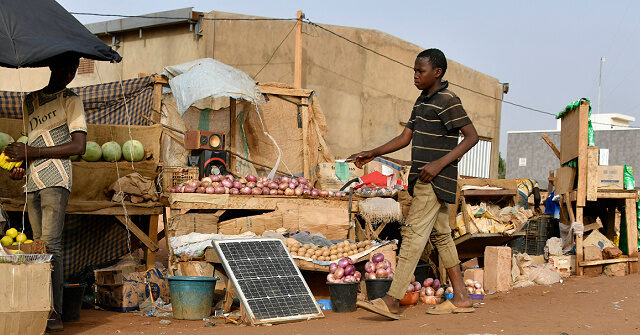
Photo: Breitbart News
How Russian Mercenaries Helped Niger's Junta Survive a Soldiers' Revolt
Chai! If you thought the political wahala in Niger was calming down, think again. On Sunday, Niger's military junta — the same set of soldiers that threw out democratically elected President Mohamed Bazoum in July 2023 — announced that it had crushed a violent 24-hour uprising from within its own ranks. And according to the junta itself, they couldn't have done it without help from Russian mercenaries. Yes, you heard that right. Wagner-linked fighters — or whatever rebranded name they are going under these days — reportedly helped keep General Abdourahamane Tchiani's government from collapsing like a house of cards in a Harmattan wind.
Now, before we dive into the full gist, let's pause and appreciate the irony here: a military government that seized power by force is now fighting off its own soldiers who apparently had their own grievances. It's coup within a coup energy, and e no funny at all.
The Mutiny That Almost Wasn't
Details from Niamey are still sketchy — as expected from a junta that doesn't exactly hold press conferences like Town Hall meetings — but here is what we know so far. A faction of disgruntled soldiers, reportedly unhappy with the direction of the military government, attempted to overthrow or destabilize the ruling council. The unrest lasted roughly 24 hours before it was put down. The junta credited Russian mercenary forces — believed to be linked to what remains of the Wagner Group, now operating under the Africa Corps umbrella since Yevgeny Prigozhin's very dramatic death — for helping to restore order.
This is not the first time Russian operatives have been central to propping up a Sahel junta. We've seen it in Mali and Burkina Faso. Niger has now officially joined that club. And brother, this is a big deal — not just for Niger, but for every single country in West Africa, especially Nigeria.
ECOWAS Threatened Military Action — Then Did Nothing
Cast your mind back to August 2023. When Niger's coup happened, ECOWAS — led largely by Nigeria's then-President Bola Tinubu who was also serving as ECOWAS Chair — made plenty of noise. They issued ultimatums. They talked about restoring democratic order. They even floated the idea of military intervention. Nigerians and regional observers were watching closely.
But e no happen. The military intervention never came. Niger, Mali, and Burkina Faso — who had already formed their own Alliance of Sahel States (AES) — collectively told ECOWAS to go and sit down. They withdrew from the bloc entirely. Sanctions were imposed but later relaxed as humanitarian concerns mounted. Nigeria, which shares a long border with Niger, had too much at stake — economically, in terms of energy infrastructure, and in terms of the millions of people who cross that border regularly.
Now, with Russian mercenaries entrenched inside Niger and helping the junta survive internal rebellions, the question on every serious analyst's lips is: has ECOWAS completely lost the plot?
What Russian Boots on Sahel Ground Means for West Africa
Make we be very clear about something: Russian mercenaries don't come cheap, and they definitely don't come without strings attached. Wherever Wagner — now Africa Corps — has set up shop, a familiar pattern follows:
- Natural resource deals: In Mali and Central African Republic, Russian forces have been linked to gold mining concessions and other resource extraction agreements. Niger sits on massive uranium deposits. You think Russia is there for jollof rice?
- Prolonged military rule: Having Russian muscle around gives juntas the confidence to ignore democratic pressure. Why would Tchiani negotiate with ECOWAS when he has Russian firepower backing him up?
- Anti-Western alignment: French forces were kicked out. American troops were told to pack their bags. The strategic tilt away from traditional Western partners is deliberate and accelerating.
- Regional destabilization: Mercenary activity in one country rarely stays contained. With porous borders and active jihadist movements in the Sahel, the ripple effects of this instability will eventually knock on Nigeria's northern door.
Nigeria's Shrinking Influence — Abeg, Let's Talk About It
This one pains me to write, but we have to be honest. Nigeria used to be the big uncle of West Africa. The country that set the tone, that other nations looked to for leadership. Lagos is still the economic heartbeat of the region. The Nigerian military has historically been the backbone of ECOWAS peacekeeping missions from Liberia to Sierra Leone.
But right now? Nigeria's influence in the Sahel is at one of its lowest points in decades. The country is dealing with its own internal security crises — from Boko Haram remnants in the Northeast to banditry in the Northwest to separatist tensions in the Southeast. President Tinubu's government has had its hands full managing an economy battered by fuel subsidy removal and naira devaluation. Finding the bandwidth to lead a coherent West African security strategy has clearly been a challenge.
And while Nigeria was managing its domestic affairs, Russia moved in. Quietly. Strategically. With mercenaries and mining deals and military advisors.
So What Happens Next?
The Niger junta surviving this internal mutiny — with Russian help — means Tchiani's government is likely to grow more emboldened, not less. Any remaining hope that international pressure would nudge Niger back toward civilian rule is fading fast. ECOWAS needs to rethink its entire approach to the Sahel crisis, because the current strategy of issuing statements and hoping for the best clearly isn't working.
For Nigeria specifically, this moment demands serious strategic thinking. The northern border with Niger is not just a line on a map — it is a highway for people, goods, and unfortunately, also arms and militants. A Niger increasingly under Russian influence and with a volatile military government is a security headache that will eventually become Nigeria's problem whether Abuja likes it or not.
The big question is: will Nigeria and ECOWAS find a smarter, more effective approach — one that balances democratic values with the real-world complexity of Sahel politics? Or will they continue to watch from the sidelines while Russia makes itself at home in Nigeria's backyard?
As them say for street: the matter don pass just Niger. This na our wahala too.
Comments
Post a Comment