


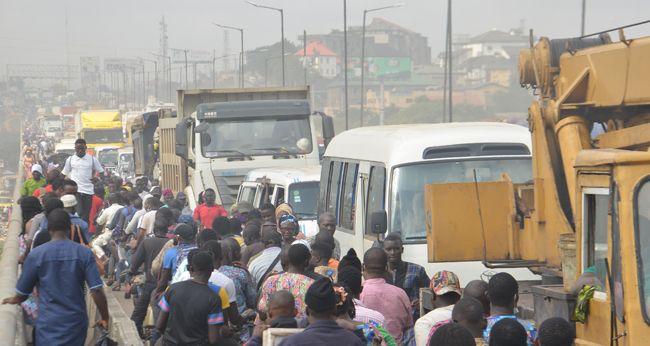
Photo: Vanguard
Lagos-Ibadan Expressway Becomes a Parking Lot as Kara Bridge Repairs Bite Hard
If you were anywhere near the Lagos-Ibadan Expressway yesterday, e no need anybody tell you say wahala dey. Motorists and commuters were left stranded for several agonizing hours as ongoing rehabilitation works on the Kara Bridge — sitting right at the Lagos-Ogun border — turned one of Nigeria's busiest expressways into what many frustrated road users are now calling "the world's longest car park."
From early morning, the gridlock stretched for kilometers, swallowing cars, buses, and trucks whole. Danfo drivers, trailer operators, private car owners — nobody was spared. The sun was blazing, tempers were rising, and for thousands of ordinary Lagosians just trying to get to work, school, or the market, yesterday felt like a punishment they did not sign up for.
The Suffering Was Real — Ask Anyone Who Was There
Let's talk about the human side of this thing, because the statistics won't capture what people actually went through. Imagine waking up at 5am, joining the road before 6am, and still not making it past Kara Bridge by 10am. That is not a movie — that was real life for hundreds of commuters yesterday.
One woman who spoke to our correspondent said she had been on the road for over four hours just trying to reach her workplace in Ikeja. "I left Mowe by 5:30am. By 10am, I had not even passed Kara. My oga don call me three times. What do I tell am?" she lamented, visibly exhausted and sweaty.
A commercial bus driver heading into Lagos from Sagamu added, "We dey here since morning. The passengers are complaining, but wetin we go do? The road is blocked. Government do this thing without warning people properly."
For traders carrying perishable goods — vegetables, fish, tomatoes — the gridlock was more than an inconvenience. It was a direct financial loss. Goods that should have reached Mile 12 or Oyingbo markets fresh were wilting under the Lagos heat inside stationary vehicles. No buyer. No profit. Just loss.
Transport Fares Shot Up Like Rocket Fuel
Now here is where the wahala gets even worse for the common man. As word spread about the gridlock, commercial drivers and bus operators did what they always do in Lagos when supply of rides cannot meet demand — they raised their prices sharp sharp, and with zero apology.
Routes that normally cost between ₦500 and ₦800 were going for ₦1,500 to ₦2,500 within hours. Some tricycle operators around the affected areas were charging even more for short distances, knowing fully well that desperate commuters had no choice. This is the classic Lagos hustle — when the road bleeds, the transporters feast.
For civil servants, market women, and daily wage earners already struggling with the current cost of living in Nigeria, this spike was genuinely painful. A man who identified himself as a security guard said he had to borrow money from a colleague just to afford transport home after his shift. "The same road I take every day, today dem charge me double. Where the money go come from?"
Kara Bridge: Why Is This Repair Taking So Long?
The Kara Bridge rehabilitation is not exactly breaking news — the project has been going on for a while now. The bridge, which connects Lagos State to Ogun State along the Lagos-Ibadan corridor, is one of the most critical infrastructure points in Southwest Nigeria. Millions of vehicles and commuters pass through it weekly.
The rehabilitation is necessary — nobody is arguing against fixing a failing bridge. But the execution? That is where serious questions need to be asked. Why is there no adequate traffic management system in place during these repairs? Why are motorists not being properly rerouted or given timely information about alternate routes? Why does it seem like the people planning these works don't actually use the roads themselves?
Lagos and Ogun state traffic management authorities, along with the Federal Roads Maintenance Agency (FERMA), need to answer for the chaos that happened yesterday. Fixing a bridge while grinding an entire expressway to a halt — without a solid traffic diversion plan — is simply not good enough.
Alternate Routes? What Alternate Routes?
In theory, commuters can use alternative routes to avoid the Kara Bridge area. In practice, those roads are either in terrible condition, poorly lit, insecure, or completely unknown to the average Lagos driver who relies on routine. Many commuters said they had no idea what other options were available to them.
Some of the alternate suggestions being shared on social media included:
- Using the Sagamu-Ore road and entering Lagos through Ikorodu
- Taking the Mowe/Ofada bypass roads through Abeokuta Expressway
- Leaving extremely early (before 4am) to beat the worst of the congestion
- Working from home if your employer allows it
But for daily wage earners who must show up physically to earn their living, "work from home" is not a luxury they have. The burden falls, as always, on the most vulnerable.
Lagos Cannot Keep Doing This to Its People
Look, infrastructure development is important. We need fixed bridges. We need good roads. But the way these projects are being managed is causing real, measurable pain to millions of Nigerians who are already stretched thin. Between skyrocketing food prices, fuel costs, and now transport fare spikes from avoidable gridlocks, the average Lagos resident is being squeezed from every corner.
The authorities — federal, state, and local — need to do better. Proper advance communication, well-organized traffic control, clear diversion routes, and real-time updates are not luxuries. They are basic requirements for any responsible infrastructure project on a road as critical as the Lagos-Ibadan Expressway.
Yesterday, thousands of Lagosians lost hours of their lives, money from their already-thin pockets, and a piece of their patience — all because of poor planning around a repair project. That should not happen again. We go dey watch.

Comments
Post a Comment