

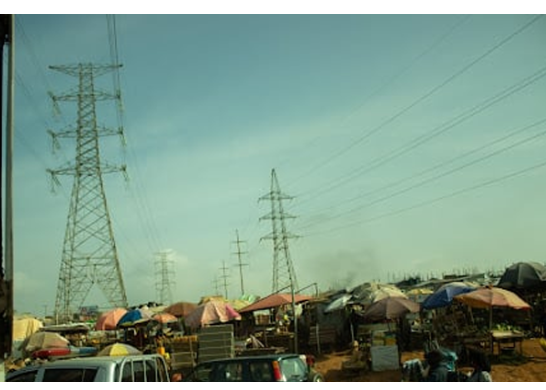
Photo: Vanguard
Children as Guinea Pigs: The Agbado Oke Scandal That Should Shake Every Nigerian Parent
Make we talk the truth — if this was happening in Maitama, Abuja or Victoria Island, Lagos, the story for don different. But because it is Agbado Oke, a densely packed community where ordinary Nigerians hustle every day, the authorities apparently decided say the lives of these children no too important to protect. For more than two full decades, pupils of Clementine Schools in Agbado Oke, Lagos State, have been resuming every single morning directly beneath two high-voltage electricity transmission lines. Two decades, my people. That is longer than some of these children have even been alive.
This is not a village in the bush where information no reach. This is Lagos — the commercial capital of Africa's biggest economy. A city where EKEDC (Eko Electricity Distribution Company) and the Transmission Company of Nigeria (TCN) both operate, collect bills, attend conferences, and issue press releases. Yet somehow, neither agency saw anything wrong with letting hundreds, possibly thousands, of school children sit, play, eat, and learn directly underneath live high-voltage cables for over twenty years. Somebody needs to explain this to Nigerians, and they need to explain it now.
What Exactly Is the Risk? Let's Not Mince Words
In case anyone is wondering whether this is just alarmism, let's be very clear about what high-voltage transmission lines do to the human body — especially developing children. Research from institutions around the world, including the World Health Organisation (WHO), has consistently flagged concerns about prolonged exposure to electromagnetic fields (EMFs) generated by high-voltage lines. The concerns include increased risk of childhood leukaemia, neurological effects, and other long-term health complications. Some studies have been inconclusive, yes — but the precautionary principle is clear: you do not build schools under high-voltage lines, and you definitely do not leave them there for twenty-plus years.
Beyond the long-term health risks, there is the very immediate danger of electrical faults. High-voltage transmission lines can sag during extreme heat. They can snap during storms. A conductor failure or equipment malfunction can result in electrical discharge that kills instantly. We are talking about children, and we are talking about a school setting. The fact that a catastrophic incident hasn't happened yet is not a testament to good governance — it is pure luck, and luck has an expiry date.
Where Was EKEDC? Where Was TCN? Where Was the Lagos State Government?
Ehen, this is where the real pepper enters the soup. Because you see, this is not a situation where nobody knew. High-voltage transmission lines don't appear overnight like mushrooms. The infrastructure was there. The school was there. Regulators, local government officials, Lagos State Ministry of Education — all of these institutions had the responsibility to act. Let us break down who failed:
- TCN (Transmission Company of Nigeria): As the federal agency responsible for managing Nigeria's high-voltage transmission infrastructure, TCN had the primary obligation to ensure that no residential or institutional structures — especially schools — exist within the dangerous right-of-way (RoW) corridor of their lines. Where was their monitoring? Where were their field engineers? Did anyone visit Agbado Oke in twenty years?
- EKEDC: As the distribution company servicing that axis of Lagos, EKEDC equally had regulatory and safety reporting obligations. Safety violations within their operational zone should be flagged, escalated, and resolved. Apparently, that did not happen here.
- Lagos State Government: The Ministry of Education approves schools. The Ministry of Environment enforces safety standards. The local government area should be conducting inspections. How did Clementine Schools receive and maintain operating approval while sitting under high-voltage lines for over two decades? Someone signed those papers. Someone renewed those approvals. We need names.
- The Nigerian Electricity Regulatory Commission (NERC): NERC exists precisely to regulate the conduct of electricity companies and enforce safety standards across the industry. If EKEDC and TCN violated established safety corridors for this long, NERC has regulatory questions to answer.
The Children and Families Deserve More Than Sorry
You know what irritates Nigerians the most about situations like this? The fact that when something finally blows up — literally or figuratively — the agencies involved will issue a press statement full of grammar, promise an "investigation," set up a "committee," and then nothing happens. The families of children who attended Clementine Schools over the past two decades deserve concrete action, not bureaucratic poetry.
First, there must be immediate medical screening for all current and former pupils who spent significant time on those school premises. If there are health consequences linked to their exposure, the government and relevant agencies must take financial and medical responsibility. Full stop. Second, the school must be immediately assessed and, if necessary, relocated or the power lines rerouted — not tomorrow, not after another committee report, but now. Third, and this is non-negotiable: there must be compensation for affected families. We are not asking for charity; we are demanding accountability for documented negligence.
This Is Bigger Than One School in Agbado
If you think Clementine Schools is an isolated case, abeg think again. Across Nigeria — from Kano to Port Harcourt, from Enugu to Maiduguri — there are communities, markets, schools, and residential areas sitting dangerously close to high-voltage infrastructure. The system that failed the children of Agbado Oke is the same system operating everywhere else. The culture of regulatory negligence, of looking the other way because "nothing don happen yet," is endemic. And it will keep producing tragedies until we collectively demand better.
Every Nigerian parent sending their child to school tomorrow deserves to know that someone is watching — that there is a functional government agency whose job it is to ensure schools are safe. Right now, the evidence suggests that agency does not exist, or if it does, it has been sleeping on the job for twenty years in Agbado Oke alone.
The Time for Accountability Is Now
We are calling on the Lagos State Governor, the Minister of Power, the TCN Managing Director, and the NERC leadership to respond publicly to this situation within 72 hours. Not a vague statement — a concrete action plan with timelines, responsible officers named, and measurable outcomes for the affected community. The parents and children of Agbado Oke have waited long enough. Nigeria has a habit of treating the lives of ordinary citizens as expendable. That habit must end today. Because if we stay silent, we are all — every last one of us — licensed to be the next victim.
Comments
Post a Comment