


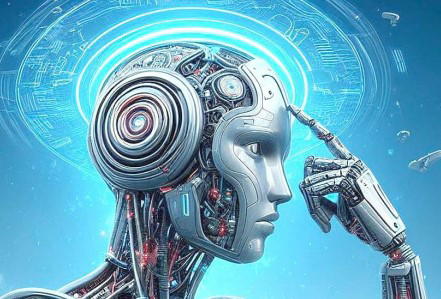
Photo: Vanguard
Oya, Let's Talk About This AI Thing Seriously
So by now, you've probably seen the headlines. Elon Musk has been shouting it. Tech professors are writing long papers about it. Even Geoffrey Hinton — the godfather of artificial intelligence himself — resigned from Google just to warn the world without holding back. The message? Artificial intelligence could one day become so powerful that humans lose control of it. Some experts are even whispering the scariest words imaginable: AI could pose an existential threat to mankind.
Now before you start panicking and hiding your laptop under the bed, let us break this down the Nigerian way — practically, honestly, and without the unnecessary drama. Because the real question for us here in Lagos, Abuja, Enugu, Kano, and everywhere in between is this: what does all of this actually mean for us?
The Truth About AI Danger — It's Not Just Terminator Movies
When people say AI could be dangerous, they're not only talking about robots walking down Allen Avenue with guns. The threat is more subtle and, honestly, more immediate. We're talking about AI systems making decisions about loans, job applications, medical diagnoses, and even criminal sentencing — often with hidden biases baked right into their code. We're talking about deepfake videos that can destroy a person's reputation overnight. We're talking about automated systems replacing entire departments in companies without a single memo being sent.
In Nigeria, where trust in institutions is already fragile and digital literacy is still growing, these risks are not abstract. They are landing on our doorstep right now. That photo your cousin shared on WhatsApp claiming to show a politician doing something scandalous? It might be AI-generated. That customer service chatbot handling your bank complaint? It's already here. The future people are afraid of abroad has quietly been arriving in Nigeria, one update at a time.
Nigerian Tech Workers: You Are Not Safe By Default
Listen, if you are a software developer, data analyst, graphic designer, content writer, or customer support agent in Nigeria, this message is specifically for you. The same AI tools that are making your work easier right now are also being trained to do your entire job without you. Companies in the United States and Europe are already cutting entry-level tech roles because of tools like ChatGPT, GitHub Copilot, and Midjourney.
Does that mean you should quit coding and open a pepper soup joint? Absolutely not. But it means you must evolve. The Nigerian tech workers who will thrive in the next decade are those who learn to work with AI, not just alongside it. Learn prompt engineering. Understand machine learning basics even if you're not a data scientist. Build products that use AI rather than just hoping AI doesn't replace your job. The Andela generation showed the world that Nigerian developers can compete globally — the next generation must show they can lead in the AI era.
Students and Graduates: Your Biggest Assignment Is Unlearning
To all the UNILAG, OAU, UNN, and ABU graduates reading this — the degree you just sweated four or five years for (or six, because ASUU go still ASUU) is still valuable. But the skill set attached to it may already be outdated in some fields. AI is not just changing what jobs exist; it is changing what skills those jobs require.
Here is your practical action plan:
- Take free AI courses seriously. Google, Coursera, and even YouTube have world-class free resources. Google's AI Essentials course, for example, costs nothing and gives you a certificate that employers actually recognize.
- Stop fearing the tools. Use ChatGPT, Gemini, Copilot — not to cheat, but to learn how they work and where they fail. Understanding AI limitations is itself a premium skill.
- Build your human advantage. Critical thinking, emotional intelligence, ethical reasoning, creative problem-solving — these are things AI genuinely cannot replicate. Invest in them deliberately.
- Find your intersection. The most valuable person in any room will soon be someone who understands both the human problem AND the AI solution. Be that person in your field — whether it's agriculture, medicine, law, or finance.
Everyday Nigerians: The Threat You Should Actually Worry About
For the trader in Balogun market, the nurse in a government hospital, or the teacher in a public secondary school — the existential robot apocalypse is not your most urgent problem. Your AI concern should be more immediate: misinformation, scams, and being left behind.
AI-powered scams are getting frighteningly sophisticated. Voice cloning technology can now replicate your relative's voice to beg you for urgent money. Fake news generated by AI is spreading faster than NEPA takes light. If you are not sharpening your ability to verify information and question what you see online, you are vulnerable — period.
Also, as government services, banking, and healthcare increasingly move toward AI-assisted platforms, Nigerians without digital access or literacy will face new forms of exclusion. This is why advocacy matters. Push your local government representatives. Demand that AI literacy be included in school curricula. Ask hard questions about how public institutions are using these tools.
So, Should We Be Afraid?
Fear without action is just anxiety. And Nigerians have never been people who just sit down and accept whatever situation they find themselves in. We hustle. We adapt. We innovate under conditions that would break most people.
The global conversation about AI safety is important, and yes, the risks are real — from biased algorithms to potential misuse by governments and corporations. But Nigeria's response cannot be to watch from the sidelines while the world debates. We must be active participants in shaping how AI is developed, deployed, and governed — including right here at home.
The National Information Technology Development Agency (NITDA) has begun conversations about AI policy in Nigeria. Civil society groups and tech communities like the Lagos AI community and various developer hubs across the country are doing the work. Join them. Contribute. The future of AI in Nigeria will be written by Nigerians — or written for us by someone else. The choice, as always, is ours to make.
E don be like say the machines dey come. The question is — are you ready to meet them?

Comments
Post a Comment