

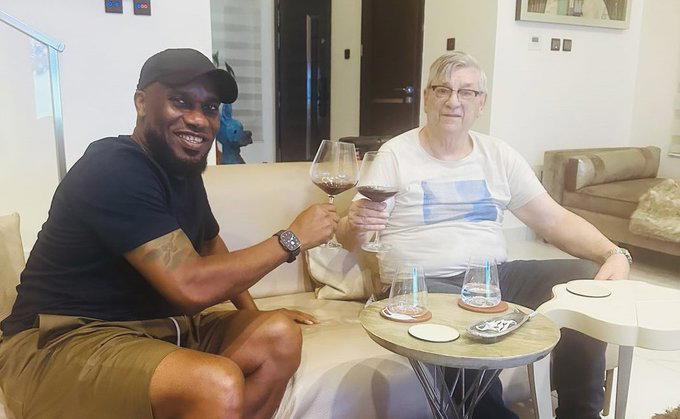
Photo: Vanguard
When a Foreign Coach Cares More Than We Do
Ah, this one enter well well. Clemens Westerhof — the Dutch tactician who gave us some of the sweetest Super Eagles memories of the 1990s — has put pen to paper and written directly to President Bola Tinubu, begging Nigeria to restore the glory of a football team that once made the whole of Africa stand up and salute. If that doesn't tell you something is deeply wrong with Nigerian football right now, I don't know what will, my friend.
Think about it for a second. A man who coached Nigeria over three decades ago, watched from thousands of kilometres away in Europe, and still feels enough pain in his chest to write a formal letter to our president. Meanwhile, many of us at home have practically moved on, changing the channel when the Super Eagles play. The irony is so thick you could chew it like pomo.
Those Golden Days We Keep Talking About
Let's take a quick trip down memory lane, because this is important. Under Westerhof's guidance between 1989 and 1994, the Super Eagles became something truly special. This was the era when Nigerians didn't need Google or Wikipedia to tell them who was in the starting lineup. Ordinary bus conductors in Lagos, market women in Onitsha, mechanics in Kano — everybody knew the first eleven by heart.
Rashidi Yekini. Stephen Keshi. Finidi George. Jay-Jay Okocha. Nwosu. Amokachi. These weren't just names — they were household gods. Children named their street football teams after these men. Parents told their kids bedtime stories featuring Super Eagles goals. The passion was organic, real, and completely nationwide.
When Nigeria qualified for their first-ever FIFA World Cup in 1994 under Westerhof, the country literally shut down to celebrate. Entire streets in Lagos were dancing. The Super Eagles weren't just a football team — they were a symbol of national pride at a time when Nigeria desperately needed something to smile about.
So What Did Westerhof Actually Say?
According to reports from Vanguard News, the veteran coach's letter to President Tinubu is essentially a passionate wake-up call — a veteran outsider looking in and seeing what many insiders have either normalised or chosen to ignore. Westerhof is said to be concerned about the structural decay in Nigerian football, from grassroots development to the management of the senior national team.
The man isn't writing because he wants a job or has something to gain. He's writing because he genuinely loves Nigerian football and remembers what it was capable of. That, my people, is what you call authentic concern — the kind that Nigerian football administrators should be showing every single day but clearly are not.
The Painful Disconnect of Today's Super Eagles
Here is the uncomfortable truth that we must face: ask a random Nigerian today to name the Super Eagles first eleven, and most people will struggle. Not because Nigerians have stopped loving football — God forbid. We still watch every Premier League game like our lives depend on it. We can argue Arsenal vs Manchester City tactics for three hours straight without blinking.
But the Super Eagles? E don become something else entirely. The connection between the average fan and the national team has broken down badly. And this isn't just about results — although the results haven't been great either. It's about something deeper: the feeling that the team represents us, that the players are fighting for something beyond their personal contracts and image rights.
When was the last time a Super Eagles performance made you jump out of your seat in genuine, uncontrollable joy? When was the last time a goal had you running into the street to celebrate with your neighbours? If you're struggling to remember, you are not alone.
The Real Problem: Structure, Not Stars
Nigeria still produces exceptional football talent — that's not the issue. Victor Osimhen is one of the most dangerous strikers on the planet. Ademola Lookman is lighting up Serie A. We have quality in various European leagues. The problem is everything around these players: the administration, the coaching consistency, the grassroots pipeline, and frankly, the political interference in football governance that has become a full-time Nigerian sport on its own.
Consider this:
- Nigeria has changed coaches more times than most countries change their football jerseys
- The Nigerian Football Federation (NFF) has been rocked by governance controversies that have distracted from actual football development
- Domestic league football — the NPFL — remains largely ignored by the average Nigerian fan, meaning the pipeline from home-based players to the Super Eagles is almost nonexistent
- Youth football investment remains painfully inadequate compared to the talent Nigeria naturally produces
Westerhof understands this. His letter is essentially saying: fix the foundation, Mr. President, and the glory will return.
What President Tinubu Should Actually Do
Now, will Tinubu read this letter personally? Probably not — the man has a whole country to manage. But the message needs to land on the right desks and inspire the right actions. Nigerian football needs presidential-level attention and political will to reform its structures.
The Sports Ministry, working alongside a truly reformed NFF, needs to develop a clear long-term vision for Nigerian football. Not a four-year plan tied to election cycles, but a genuine 10-20 year roadmap that prioritises grassroots development, domestic league investment, and stable national team management.
Because here's the thing — when the Super Eagles were great, Nigeria felt great. Football was one of the few things that united this wonderfully complex, beautifully chaotic country of over 200 million people. Muslim and Christian, Yoruba and Igbo and Hausa, rich and poor — everyone stood under the same green flag when Rashidi Yekini scored.
E No Too Late
The good news is that Nigerian football is not beyond saving — not by a long shot. The talent is still there, the passion is dormant not dead, and clearly, even old coaches from the Netherlands still believe in us.
Westerhof's letter is a reminder that Nigeria's football legacy is worth fighting for. Let's hope someone in Aso Rock is listening. Because the day ordinary Nigerians can once again argue passionately about Super Eagles tactics the way they argue about their favourite EPL clubs — that's the day we'll know we've gotten our football soul back.
And trust me, that day cannot come soon enough.
Comments
Post a Comment